

Introduction
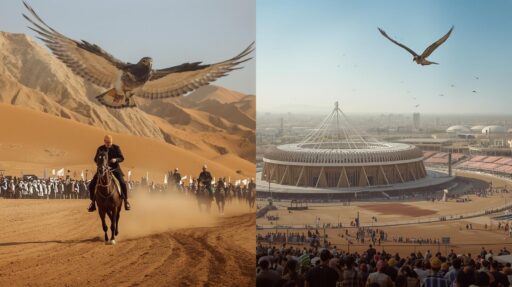
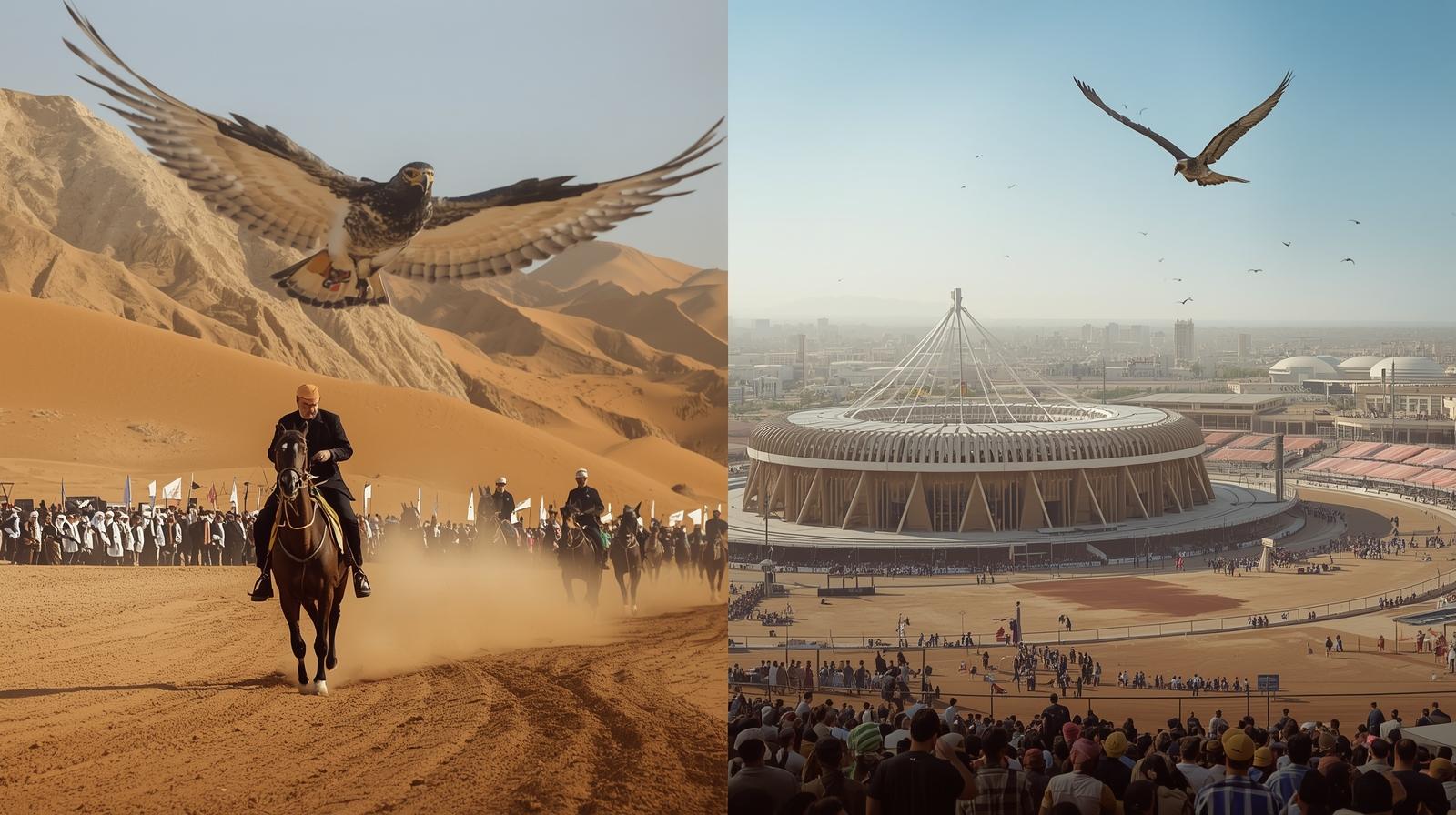
Falconry, the ancient art of hunting with birds of prey, is woven into the very soul of the UAE’s heritage. For the Bedouin, it was an essential survival skill, a partnership between human and bird in the harsh desert environment. Today, while the necessity for hunting has faded, the passion for falconry has not only endured but has evolved into a highly organized and prestigious competitive sport. The transition of falconry from a practical desert pursuit to a modern stadium event, complete with strict rules, advanced technology, and international competitors, illustrates a remarkable journey of cultural adaptation and preservation.
The Traditional Hunt: A Test of Skill and Partnership
In its original form, falconry was the ultimate test of a hunter’s knowledge, patience, and bond with his falcon. The process involved trapping passage falcons during their migration, a delicate and skilled task known as “diyara.” The falcon would then be trained through a painstaking process of trust-building and conditioning. The hunt itself, typically for houbara bustard or stone curlew, was unpredictable and demanded a deep understanding of the desert, the prey, and the bird’s capabilities. Success was measured not by a trophy but by the provision of food, and the relationship between falconer and bird was one of mutual dependence and deep respect.
The Birth of Modern Competition: The “Al Mal” and “Al Hur” Races
As hunting declined, falconers sought new ways to test their birds’ skills, leading to the creation of formal competitions. The two main types of modern falconry contests are straight-line speed races and endurance races. The most common is the “Al Mal” (wealth) competition, a straight-line sprint where falcons are released to fly to their owner’s lure over a set distance of 400 or 600 meters. The birds are timed with astonishing precision, often using RFID chips attached to their legs. The “Al Hur” (free) competition is a test of endurance, where the falcon must circle in the air for the longest duration before being called down to the lure. These competitions translate the falcon’s innate wild abilities—speed and stamina—into a quantifiable and thrilling spectator sport.
Technology and Tradition: A New Era for an Ancient Sport
The modernization of falconry competitions is starkly visible in the technology employed. Races are now held in state-of-the-art falconry complexes, like the Al Marmoum Desert in Dubai. The starting gates are sophisticated, automated systems that open simultaneously to ensure a fair start. The RFID timing systems provide results accurate to a thousandth of a second. Drones are sometimes used to lift the lure to a great height, simulating the flight of prey and encouraging the falcons to climb and stoop with spectacular speed. This embrace of technology has not diluted the tradition but has instead given it a new, measurable, and globally accessible language.
A Global Gathering: The UAE as the Falconry Capital of the World
The UAE has positioned itself as the undisputed global capital of modern falconry. It hosts premier international events like the Fazza Championship for Falconry and the Abu Dhabi Falconry Festival, which attract the best falcons and falconers from across the Gulf, Europe, and beyond. These events are more than just competitions; they are major cultural gatherings that include heritage markets, educational seminars, and veterinary conferences. They have elevated falconry from a regional pastime to an international sport, all while reinforcing the UAE’s role as the primary custodian of this ancient Arabian tradition.
Conclusion: Soaring into the Future
The evolution of falconry from desert hunt to stadium sport is a testament to the UAE’s dynamic approach to heritage. It has taken a practice rooted in necessity and reimagined it for a new era, ensuring its relevance and excitement for future generations. The sight of a Peregrine falcon exploding from its gate and streaking across the sky at over 100 km/h is a breathtaking fusion of ancient instinct and modern competition. In these high-stakes races, the soul of the Bedouin hunter lives on, not in the pursuit of sustenance, but in the enduring pursuit of excellence, partnership, and the sheer, majestic beauty of the falcon’s flight.